
Calendula (Calendula officinalis): The Golden Healer of Herbal Medicine
Calendula, often called pot marigold, is one of the most beloved herbs in modern herbalism. I know it is definitely one of my favorite herbs, and a flower that I look forward to growing and harvesting every year. Today, let us dive into the historical use of calendula along with the science that makes it such an effective remedy.
Known for its bright golden blooms and powerful skin‑healing properties, calendula has earned a place in apothecaries, homesteads, and clinical herbal practices worldwide. Its therapeutic range is broad, from wound healing and inflammation reduction to immune modulation and antimicrobial support. Making it a cornerstone herb for both beginners and advanced herbalists. A true staple in any home apothecary!

Folklore and Traditions
Calendula has been historically cultivated by nearly every major empire: Egyptian, Greek, Hindu, Arab, Chinese, and beyond. Wherever people tended gardens, calendula followed, its bright golden flowers echoing the warmth and vitality of the sun. That resemblance wasn’t lost on ancient healers: in the Doctrine of Signatures, plants were often used for the organs they symbolically mirrored. Calendula’s radiant orange and yellow blooms were seen as miniature suns, and the sun has long been tied to the heart, vitality, and the life‑force itself.
Across cultures, calendula was folded into balms, salves, and poultices, pressed directly onto wounds, burns, and inflamed skin. Its uses were, and still are, remarkably broad. In Italy, calendula tea was brewed to lower fever and soothe chronic inflammation. In India, it remains a favorite remedy for skin abrasions, burns, and hemorrhoids. Teas were also used for eye complaints like conjunctivitis, offering gentle relief to irritated tissues.
In medieval Europe, calendula’s solar symbolism took on a devotional tone. The flowers were woven into garlands to honor the Virgin Mary, earning the name Mary’s Gold, the root of the modern word marigold. In astrological herbalism, calendula is aligned with Leo, ruled by the sun, and used to treat “hot” conditions of the heart and blood.
Calendula’s story threads through the writings of Egyptian healers, Greek physicians, Ayurvedic practitioners, Arab scholars, Chinese herbalists, and medieval European monks. It was a staple in monastic gardens and later in early American homesteads, where it colored soups and tended wounds with its resinous, golden medicine.
Cultivation, Anatomy & Harvesting
Plant Anatomy
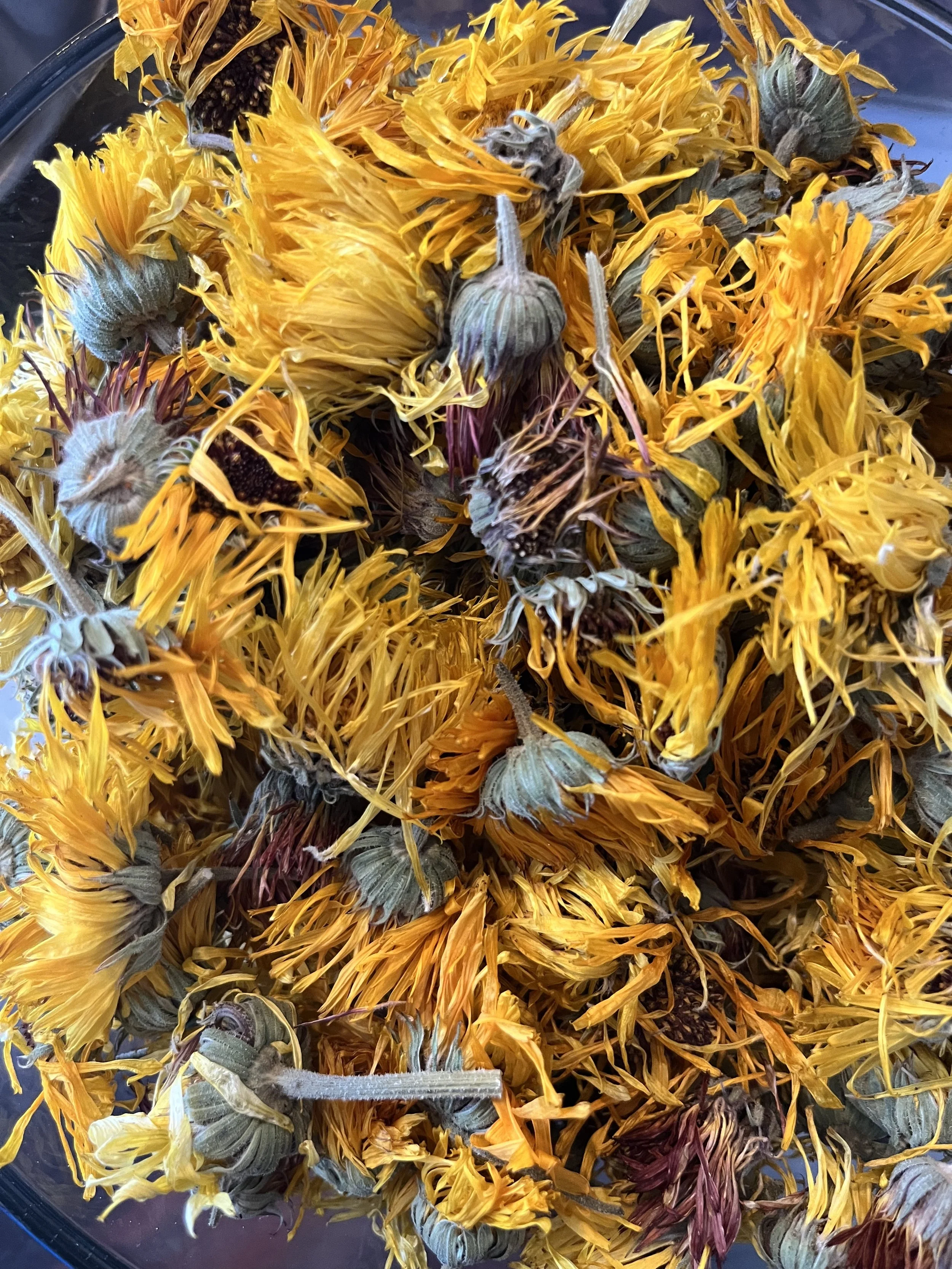
Calendula is a self‑seeding annual with bright yellow or gold composite flowers that bloom generously from May through October. Its vibrant green oval leaves branch from a central stem that sends out multiple offshoots, creating a soft, bushy shape. The flower heads — sticky, resinous, and rich with medicine — measure 5–7 cm and rise on long leafy stems.
Growing Conditions
Native to central Europe and the Mediterranean, calendula adapts easily to homestead gardens across North America and Europe. It thrives in full sun, prefers well‑drained soil, and rewards even minimal care with abundant blooms. Once established, it often reseeds itself, returning year after year with cheerful reliability.
Common Pests
Calendula is generally hardy but may attract:
aphids
whiteflies
slugs
Organic management includes neem spray, hand‑picking, and encouraging beneficial insects.
Harvesting the Flowers
The flower is the primary medicinal part of calendula. For peak potency, harvest when the bloom is fully open but before the petals begin to curl or fade. Morning harvests are ideal — the terpenoid content is highest before the midday sun warms the blossoms.
Calendula’s resin attracts many insects, so a gentle rinse is helpful. Dry the flowers thoroughly, paying special attention to the thick central disk, which holds moisture longer than the petals. Once fully dried, store in airtight containers to preserve color, scent, and medicinal strength.
Check out my blog for a full guide on how to properly dry and store your herbs, Dry Herb Storage: Preserving Potency and Plant Wisdom!
Therapeutic Applications
Calendula is one of those herbs whose traditional uses and modern research align almost perfectly. Across cultures and centuries, healers reached for calendula to soothe, cool, mend, and protect. Today, scientific studies confirm the potency behind those instincts.
Traditional Uses Across Cultures
For thousands of years, calendula has been used as an emollient, vulnerary, anti‑inflammatory, uterine tonic, and antimicrobial remedy. Its bright resinous flowers were infused into oils, salves, and teas to:
calm inflamed or irritated skin
support wound healing and tissue repair
soothe burns, abrasions, and hemorrhoids
reduce fever and systemic inflammation
ease digestive irritation
treat eye complaints like conjunctivitis
In kitchens, calendula petals were even used as a saffron substitute, lending color and warmth to soups, breads, and broths.
Modern Research & Clinical Actions
Contemporary studies reveal a pharmacological profile that mirrors calendula’s long history of use. Its resin-rich flower heads contain:
sesquiterpene & flavonol glycosides
triterpenoid saponins & alcohols
flavonoids, carotenoids, xanthophylls
phenolic acids, sterols, mucilage, tocopherols, calendulin
These compounds contribute to a wide range of clinically observed actions:
Anti‑inflammatory — triterpenoids (faradiol esters, taraxasterol derivatives, oleanane glycosides) show potent inhibition of chemically induced inflammation, comparable to NSAIDs in animal models.
Antioedematous — reduces swelling from burns, croton oil, dextran, and lymphatic congestion through macrophage activation.
Antibacterial & Antifungal — effective against periodontal pathogens and multiple Candida species, including resistant strains.
Antiviral — tinctures inhibit herpes simplex and influenza A2/APR‑8 viruses in vitro.
Anti‑HIV — extracts inhibit HIV‑1 reverse transcriptase and suppress viral fusion.
Anticancer — triterpene glycosides demonstrate cytotoxicity across leukemia, colon cancer, melanoma, renal cancer, and breast cancer cell lines via cell‑cycle arrest and caspase‑3 apoptosis.
Immunomodulatory — stimulates B‑cells, CD4+ T‑cells, NK/NKT cells; polysaccharides increase granulocyte phagocytosis.
Hepatoprotective — reduces CCl₄‑induced liver injury and shows anti‑hepatoma activity.
Antioxidant — flavonoid-rich fractions inhibit lipid peroxidation; petal extracts outperform whole flower heads.
Wound Healing — increases collagen, hydroxyproline, and hexosamine; reduces acute‑phase proteins and oxidative damage.
Spasmolytic & Spasmogenic — dichloromethane fractions relax smooth muscle via calcium channel blockade, while aqueous fractions stimulate contraction at higher doses.
Insecticidal — active against milkweed bugs.
Cardiac Effects — aqueous extracts inhibit heart contractility at low concentrations.
Genotoxic / Antigenotoxic — polar extracts reverse DEN‑induced DNA damage at low doses but induce DNA synthesis at higher doses.
Real‑World Applications
Herbalists today use calendula for:
surgical wound healing
diaper rash
varicose ulcers
post‑mastectomy inflammation
chronic otitis media
These modern applications echo centuries of calendula’s role as a gentle yet powerful healer.
Extraction Methods & Home Preparation
Calendula’s constituents extract beautifully into multiple mediums:
Cold‑infused oils — ideal for salves and balms; capture resinous triterpenoids.
Alcohol tinctures — extract flavonoids, bitters, and triterpenoids.
Steam distillation — yields essential oil with strong antifungal activity.
Home extraction tips:
Use fresh or fully dried flowers, infuse in high‑quality oils (olive, jojoba, sunflower), and store extracts away from heat and light to preserve potency.
Formulations, Recipes & Dosage Guidelines
Calendula Tea
1–2 tsp dried flowers
Steep 5–10 minutes
Drink 2–3 cups daily
Calendula Oil
Fill a jar with dried flowers
Cover with olive oil
Infuse 4–6 weeks
Strain and store
Calendula Salve
Melt beeswax + calendula oil
Add essential oils if desired
Pour into tins
Calendula Tincture
1:5 or 1:9 ratio
Use 20–90% alcohol depending on desired constituents
Dosage Guidelines
Tea: 2–3 cups daily
Tincture: 0.3–4 ml depending on preparation
Topical: apply as needed
⚠️ Cautions and Contraindications
Safety Profile
Calendula is generally safe, especially topically.
However:
Allergies may occur in individuals sensitive to Asteraceae plants.
Internal use is traditionally avoided during pregnancy due to uterotonic effects.
Use caution if taking sedative medications — animal studies suggest possible synergy.
Special Populations
Pregnancy: avoid internal use
Breastfeeding: insufficient data
Children: topical use considered safe
Hyperthyroidism: no known interactions
Conclusion
Calendula is a golden healer — a plant that bridges ancient tradition and modern science. Its bright blooms offer powerful medicine for the skin, immune system, and inflammatory pathways. Whether you grow it in your garden, infuse it into oils, or brew it into tea, calendula is a gentle yet potent ally worth incorporating into your daily herbal routines.


Read More!



Hello and welcome! I'm Eve, a Chemist turned Herbalist, sharing the wonders of plant medicine and botanical skincare. Join me on this journey to Learn, Create, and Align your Divine!